

-- MARKDOWN --
- We leveraged LLMs to **enrich** publicly available information about known vulnerabilities **(CVE and GHSA) with structured data** and clean up false information
- Inflated severity ratings, inaccurate CVSS vectors, inconsistent/lacking descriptions and slow response to disputes have previously made it difficult to **work with vulnerability data at scale**
- Our goal is to create a **scalable and deterministic approach** that enables security practitioners to process large vulnerability scan reports based on the attack vector and impact of each finding
- **We are releasing the data** and related tooling and will be updating it daily while listening to feedback
- This post also contains some interesting statistics about the CVE database to date and additional insights we've gained from helping our clients implement efficient vulnerability management processes dealing with millions of findings
# Table of contents
- [Motivation](#motivation)
- [Defining a better structure](#defining-a-better-structure)
- [Designing a sound severity logic](#designing-a-sound-severity-logic)
- [Processing findings into actionable tickets](#processing-findings-into-actionable-tickets)
- [Research process: Past, Present and Future](#research-process-past-present-and-future)
- [Old custom approach](#old-custom-approach)
- [This new approach](#this-new-approach)
- [A realistic look into the future](#a-realistic-look-into-the-future)
- [Insights from analyzing the data](#insights-from-analyzing-the-data)
- [Our severity rating vs others](#our-severity-rating-vs-others)
- [NVC severity rating vs others](#nvc-severity-rating-vs-others)
- [Disagreements between external sources when trying to synthesize structured information](#disagreements-between-external-sources-when-trying-to-synthesize-structured-information)
- [Critical vulnerabilities by vulnerability type](#critical-vulnerabilities-by-vulnerability-type)
- [Critical vulnerabilities by affected product category](#critical-vulnerabilities-by-affected-product-category)
- [CVE release frequency](#cve-release-frequency)
- [New CVE releases by vulnerability type](#new-cve-releases-by-vulnerability-type)
- [Severity distribution by language](#severity-distribution-by-language)
- [Memory management vulnerabilities by language](#memory-management-vulnerabilities-by-language)
# Motivation
A common type of security problem we've helped clients with over the years is vulnerability management.
Vulnerability scan reports in large organizations can easily contain millions of findings, and often times 10-30% of them are considered to be of "critical severity" by the scanning tool.
Some of these findings would legitimately be very critical and should be patched urgently. In some cases, part of the IT infrastructure that shows a large amount of missing patches does so because it has largely been forgotten, and onboarding it to some kind of patching process and ownership is a high priority item in itself.
But the vast majority of findings often do not actually pose a major risk. Even in the best managed IT landscapes, attempting to keep everything patched up to the standard classification into high or critical severity issues is a huge challenge that would indefinitely block a major chunk of engineering resources.
There have been products on the market that promise smart reprioritization of scan results for many years, but we have never found any them to be transparent, effective and reliable enough to have a major impact when trying to filter out the noise.
Here is our proposal for a better solution:
# Defining a better structure
The two most important questions when assessing a vulnerability are:
1. **Effects:** What would an attacker be able to do after successful exploitation?
2. **Attack path:** What is required for an attacker to succeed in exploitation?
We want the schema to be easily understandable by humans and processable by deterministic software. Enums (properties with lists of predefined values) are great for this. However, trying to compile one flat list of possible values that covers everything for each of these is not feasible, so we split them up into sub properties across multiple dimensions.
Below is a rough summary of these properties:
**Effects** are divided into a few handful of main categories, such as "code execution", "data read" and "DoS". A vulnerability can have multiple possible effects associated with it. Some effects have specific subcategories, for example "data read: credentials" or "data read: metadata".
Then there are 3 more effect properties, some of them only apply to a specific subset of the effect main categories:
- **basis**: Has the effect been clearly stated/demonstrated, or is it more speculative?
- **channel**: Exclusive to the "data read" category: Is the data exfiltration direct or does it require a side channel/separate access?
- **bounds**: Boundaries of the effect, for example if a data read/manipulation is limited to only a single attribute of data object or other users in the same group/tenant as the attacker
**Attack path** is made up of 9 dimensions that describe how an attacker could reach/trigger the described effects:
- **vector**: Main categorization of where the attacker comes from, for example: Connecting to a network service, MITM attack against network traffic or having physical access to the target
- **privileges**: What kind of privileges does the attacker need at the start (none, low, high, admin/root)?
- **interaction**: Is active, passive or no user interaction required by the victim?
- **conditions**: Various other conditions, such as having to win a race conditions or the flaw being restricted to specific platforms/deployments
- **code location**: What part of the software/package is affected? Some CVEs only describe issues in example code or even documentation
- **exposure**: How likely is a typical deployment of this software to be exposed to the internet (This is mostly guesswork by the LLM and not too reliable)
- **exploit**: Is this actively exploited in the wild?
- **protocol**: Which (network) protocol is used as part of the exploit
- **file type**: Which file type is used as part of the exploit
**Other interesting fields** in the dataset:
- **record status**: Status from the NVD CVE database (active/awaiting-analysis/disputed/rejected). We allow the LLM to make a call and set the value to "disputed" based on external evidence, even if NVD has not recognized it as such
- **Vulnerability type**: XSS, SQL injection, stack overflow, ...
- **Affected product category**: web application, IoT device, email client, ...
- **Component function**: media parsing, access control, cryptography, ...
- **Programming language**: C, Rust, Java, ...
- **Data sensitity**: The LLM's guess of how likely the affected software is to handle sensitive data (do not rely too heavily on this judgement)
You can also explore the [full schema as described by the LLM that uses it here](https://svdb.positive.security/#/schema).
# Designing a sound severity logic
Based on the schema above we built a customizable [severity logic editor](https://svdb.positive.security/#/severity?view=lanes) to calculate severities across the entire database.
The starting point is to define the base severity (0-10) for each effect (sub-)category. This base severity acts as a ceiling for how high the score for this vulnerability can be. It should be set to whatever severity you would assign to the effect if you assume that an unauthenticated remote attacker can actually achieve the effect with ease.
All changes to the base severity come from modifier groups:
A modifier group is a set of key/value pairs with an associated severity score delta (negative or positive). These modifiers/deltas can also be restricted to only be active for specific impact categories.
Within one modifier group, only the most significant positive and most significant negative delta are counted to determine the group's overall impact on the severity score. This is done to prevent double discounts from values that describe the same or similar circumstances.
**Example severity calculation:**
[CVE-2022-1292](https://svdb.positive.security/#/vuln/CVE-2022-1292) is a vulnerability in OpenSSL, which can result in code execution. OpenSSL is a component that is typically internet facing and this sounds very bad at first glance. Severity ratings for this vulnerability from other sources do not agree with each other range from 5.5 (medium) to 10 (critical).
Before we pass judgement, we check the relevant structured data:
- The effect is code execution, often in a root context
- The realistic attack vector however is not an incoming network connection. It involves write access to a local folder and a high privileged user running a command (e.g. `update-ca-certificates`) that processes files in that folder
Then we run our default severity logic:
- The code execution effect starts with a value of 10
- 4 points are subtracted for attack vector "local process or account on the host"
- Required privileges "low" would usually subtract another 2 points, but is ignored here because of the specific attack vector above that typically implies some kind of privilege level for the attacker already
- user interaction "passive" leads to 2 more points being subtracted
The resulting severity with our default logic is 4 (medium).
If you disagree with this result you can adjust the deltas in the severity logic to your own needs.
If you find any vulnerabilities where the structured data seems inaccurate, we would greatly appreciate per-record change suggestions in the UI (blue button in the top right) so we can review and integrate them.
Side note: CVSS uses a similar approach, but with much lower fidelity:
- Effects are described as "Impact metrics": Confidentiality, Integrity, Availability
- The attack path is described as "Exploitability Metrics": Attack Vector, Attack Complexity, Attack Requirements, Privileges Required and User Interaction
- The CVSS score is solely derived from the properties above
# Processing findings into actionable tickets
With the reprioritization step handled, a few more deterministic transformations of the original vulnerability scan data can help to make things a lot easier for the teams performing the patching. The following are insights we've gained from working on vulnerability management with different clients:
- A useful ticket should be focused on the required actions and can sensibly cover hundreds of individual findings. There are two main modes for grouping, both of them can be used in parallel within the same organization:
- A) **Per Asset:** One ticket per host/image/service that lists all packages and dependencies that need to be udpated on that asset (e.g. for microservices maintained by individual teams)
- B) **Per package:** One ticket per package/dependency that lists all hosts/images/services where this package needs to be updated (e.g. for admin and devops teams that automate specific bulk actions across many hosts in one go)
- Tickets should contain dense tabular data about which packages are affected and where to find them
- Which exact package version fixes an individual findings/CVE and even details about the individual CVEs are of lesser importance. The general instruction should be: If a package gets named in a patching ticket, update it to the latest available version (of your supported branch). If your branch does not receive important security updates, you must urgently perform an upgrade to a supported branch anyways
- Ticket priority should be based on the maximum severity of the findings contained within it
- Ticket priorities and the tabular data contained in them should be updated automatically and frequently. Rather than tickets that need to be fully closed, the prioritized patching TODOs could also be interpreted as dashboards that show the patching state for each asset/package and only need to be acted upon when they pass into the medium or high severity threshold
- An ownership database should be maintained that allows automatically assigning each ticket to whoever owns the affected asset
We implemented a simple version of this ticket generation flow on [svdb.positive.security/#/tickets](https://svdb.positive.security/#/tickets). The logic is based on a complete download of the index, fully executed on the client-side and there are no tracking scripts. If you try it out with real data, our server logs only have a chance to show a link between your IP and specific vulnerabilities if you browse them individually or choose to export their full descriptions in the ZIP report.
# Research Process: Past, Present and Future
## Old custom approach
Our approach to help solve vulnerability reprioritization in past consulting engagements has been to develop custom scripts and utilities. These would be used to analyze the scan data to iteratively develop heuristics that allow us to group the findings and reprioritize them based on their actual impact and exposed attack vector in the context of our client's infrastructure.
Many of the most effective heuristics would be focused on the type of the affected component and a few high-confidence keywords in the vulnerability description. For example: We would assume that a vulnerability in a GUI application or interactive CLI would always require some level of user interaction and could be deprioritized when found in a pod or application server where users are not expected to log in.
For whatever would still qualify as high or critical after passing our heuristics, we'd perform a tedious manual review of the individual vulnerabilities, weeding out the rest of the noise and bogus CVEs to spare the patching teams from wasting their time (see the [CVE-2022-1292 example above](#severity-logic)).
## This new approach
While working with these large amounts of CVEs and developing custom heuristics, we formed an idea: Someone could invest extra effort into processing the entire messy corpus of the CVE database and putting it into a more structured format for everybody else to use. This could save huge amounts of time overall and make this approach accessible for more organizations that are struggling with vulnerability management.
Before LLMs, such an endeavor would have required multiple mind-numbing full time years from human security professionals.
LLMs changed that equation, and in the beginning of 2026 we started to actually work on this.
From the start we were convinced that the correct approach had to be transparent and based on unopinionated, structured enrichment of the data. This would allow users of the data to tweak and develop their own reprioritization logic.
Approaches like [EPSS](https://www.first.org/epss/) that only produce a one-dimensional metric with a black box fall short in many scenarios: Privilege escalation/sandbox escape Kernel bugs like [CVE-2026-99999](https://svdb.positive.security/#/vuln/CVE-2026-99999) won't do much harm inside of single-purpose microservice containers, but are very relevant for virtualization hosts running untrusted workloads.
To succeed, we'd need to ensure:
1. The schema must be expressive enough to support developing versatile and actually useful reprioritization logic without any other inputs.
2. The classification pipeline must be accurate enough to deliver a good level of confidence in the data.
The first versions of the schema and classification pipeline were hand-rolled in January. Later improvements were developed with significant contributions from Claude Opus 4.8 through 5.5. These models where integral to reaching the current level of quality and sophistication, but so was strong human guidance. Even Opus 5.5 could loop endlessly on this project to extend or condense the schema, sometimes sharpening it while making it more muddy other times. It's judgements are often very good but can also be blunders, for example: Including application accounts that can always be acquired via open self-registration in the "low privileges required" category, thus giving relevant CVEs a significant severity discount with our default reprioritization logic.
The same goes for finding and correcting, but also introducing errors in the dataset. It is very good at finding anomalies and pockets of records that should be re-assessed. But if left unchecked, it will continue to develop heuristics with lower precision and apply bulk changes based on them, destroying existing nuances.
The bulk of the initial per-CVE classification work was done using DeepSeek V4 Pro. Controlled, heuristics based edits were performed with the help of Claude Opus. Since its release, GPT-6-Luna has superseded DeepSeek V4 Pro as the main workhorse and is currently responsible for classifying newly released CVEs. GPT-6-Luna was also used in targeted passes of the existing dataset to correct specific systemic issues or add properties from later schema versions.
We also benchmarked Jev and the OpenAI decision API, but found them to be less accurate and less powerful (no free text fields) than GPT-6-Luna.
In the future we might decide to introduce schema updates or a full reclassification of the dataset with a new model.
We spent a fair amount of human effort on quality control and are quite happy with both the expressiveness and the quality of the data.
Under different circumstances we might have chosen to spend even more time on further checks and refinements before publishing, but the IT world has changed significantly around us while working on this project:
## A realistic look into the future
A major appeal of this approach is that it allows harnessing the power of LLMs in structuring fuzzy data, while at the same time reducing the chance of falling victim to their sometimes unreliable nature: We want to provide a centralized resource where incorrect data can be corrected permanently with our own and crowd-sourced efforts.
At the start of 2026, many AI driven security products were still producing predominantly unstructured and unreliable output on the fly and this seemed like the perfect plan.
Since then the intelligence, reliability and affordability of LLMs have improved significantly.
If AI continues to advance at a similar pace, overinvesting effort in a central location to get a redistributable increase in quality may soon only provide a negligible benefit.
In other words: We might be heading towards a future where this project is obsoleted by every organization having cheap agents that can efficiently process huge amounts of data while reliably answering to the prompt: "How important is it really to patch this? Think about the actual impact and realistic attack scenario in the context of my IT infrastructure".
On top of that, having even the fastest and most accurate reprioritization system will only provide a diminishing part of the full answer to the patching and vulnerability management problem.
There is a rapid increase in genuinely critical published vulnerabilities, and the time gap between public release and mass exploitation has vanished.
The week of 2026-10-12 was a nightmare for many IT departments, with most of them probably having to juggle multiple simultaneous patching related incidents at the same time (eMudhra, Node2Shell, PHP2Shell, GitLab).
The responsiveness and throughput of the actual patching processes everywhere will have to be improved significantly in many places.
At the start of this year I would have said it's a crazy idea to have AI agents handle patching and other changes on live infrastructure. Now it seems to be a likely, maybe even necessary, scenario in the future.
# Insights from analyzing the data
## Our severity rating vs others
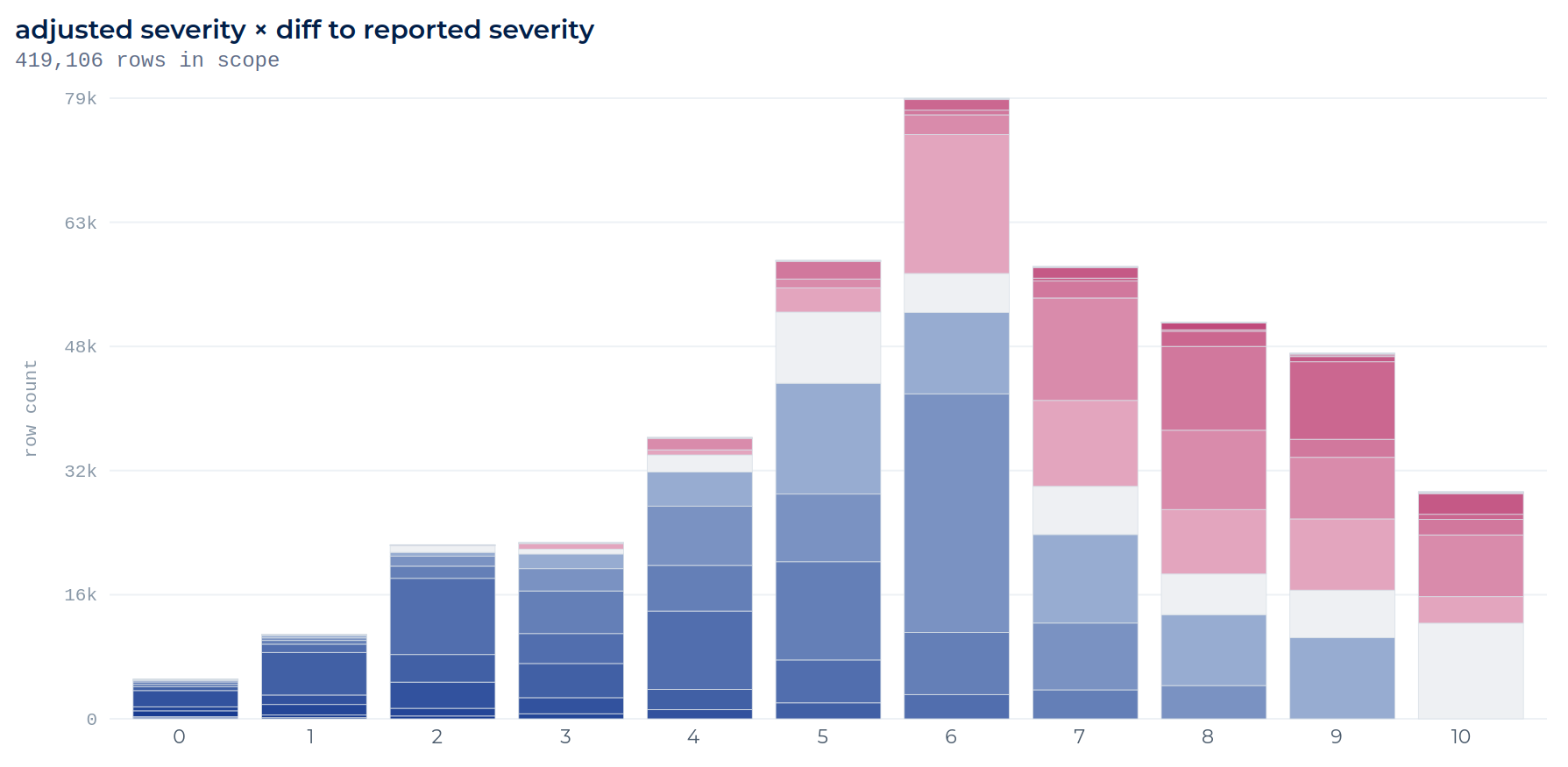
The adjusted severity rating based on our default logic disagrees quite strongly with other sources. The graph shows by how many points (0-10) our rating per vulnerability differs from other sources. The fact that our ratings are overall lower compared to other sources is a confirmation of our hypothesis and what we set out to do: Filtering out noise from CVEs with inflated severity scores
## NVD severity rating vs others
Established external sources also have strong disagreement among each other to begin with:
## Disagreements between external sources when trying to synthesize structured information
Our classification model tracked whenever different sources claimed different facts. Measured across all vulnerabilities and all fields in our schema, the graph shows at what percentage each data source was deemed the most correct and how many disputes it was involved in. CWE assignments and CVSS vectors have the lowest percentage values, which means they are least accurate according to our assessment. For CVSS we believe this has to do with its low fidelity and potentially reporters/vendors that fiddle with the dimensions semi-arbitrarily to end up with the desired severity rating. CWE categories are sometimes not worded clearly and the discoverability for more accurate values seems low, which could contribute to it's low accuracy here:
## Critical vulnerabilities by vulnerability type
When grouping by vulnerability type, we can see significant shifts in the share of vulnerabilities rated critical (score >= 9). This is mostly driven by our rating for different effects that certain vulnerability types correlate with. For example, we consider a larger percentage of path traversals (sensitive data read) and authentication bypasses to be critical, but fewer of the memory management vulnerabilities when the demonstrated effect is limited to DoS rather than code execution:
## Critical vulnerabilities by affected product category
When grouping by affected product category, we can also see shifts in the share of vulnerabilities rated critical. This shift is more related to the different attack paths that that tend to correlate with product categories. For example, web servers often handle untrusted data by design and are thus more prone to be vulnerable to truly unauthenticated remote attacks, which we categorize as most critical. Vulnerabilities in CLI/desktop/mobile applications require some form of user interaction most of the time, so we tend to rate much fewer of them critical after taking that into account:
## CVE release frequency
The frequency of newly reported CVEs has increased dramatically over the last years and months, and seems to be increasing even further thanks to AI advancements:
## New CVE releases by vulnerability type
Our dataset allows us to dig deeper and analyze trends like the increased CVE release frequency in more detail. The graph below shows the growth in new CVEs published by type in 01/25 - 10/25 vs 01/26 - 10/26. Note that this is about new CVEs published, which correlates more closely with which vulnerabilities were looked for and found rather than which were newly introduced:
## Severity distribution by language
PHP is the only language where our rating clearly tends to be higher than other sources, attributable to it's almost exclusive use in web applications that tend to be exposed to remote attacks. Languages where a larger share comes from memory management vulnerabilities (Rust, C, C++) tend to receive lower ratings from us due to the demonstrated effects commonly being limited to DoS rather than code execution:
## Memory management vulnerabilities by language
The share of memory management related vulnerabilities (Overflows, use-after-free, out-of-bounds access, null dereference, type confusion, etc.) found for software written in Rust has decreased sharply over the last few years, while staying stable for other languages. Counts also include vulnerabilities in the languages themselves:


